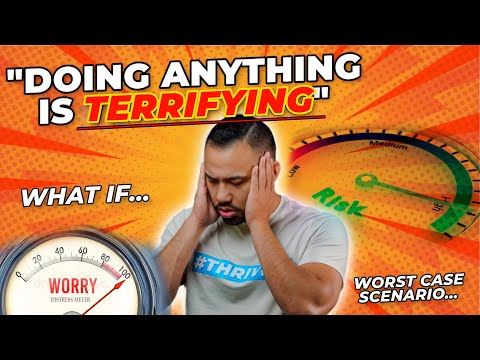
What Hypervigilance Feels Like
You walk into a mall with your family. It's a three or four minute walk to the food court. For most people that's nothing. For you, every step deeper in, the same questions start up. What if I start to dip? What if I can't catch my breath? Where's the nearest exit? And the further in you go, the louder it gets, because now the way out is a long walk back.
I lived that exact moment. I was still semi-functional at the time, and a lunch at the mall turned into a quiet emergency in my head. The walk alone used up most of my capacity. Then came the noise of the food court, people moving everywhere, orders being yelled out. Too much stimulation, and my mind kept mapping the escape.
That's what hypervigilance looked like for me. The brain is on guard, scanning for threats and planning escape routes in places where nothing dangerous is happening. It shows up as the constant what-ifs, the need to sit near the door, the dread before any outing you can't easily leave. If you're a few months into unexplained symptoms and this sounds familiar, keep reading. In my case it was one of the clearest tells that my nervous system was still on alert, and I only saw it once I knew what to look for.
The Stress Threshold and the Alarm
To make sense of it, rewind a little. Every one of us has a stress threshold, a limit to how much stress the body can handle. Physical stress counts, but so does emotional and mental stress. It all goes in the same bucket.
I was running hot for a long time before my symptoms started. I was overworking, pushing hard, skipping proper meals, living on coffee. I had that extreme type-A wiring where I couldn't take a day off without feeling guilty. Add money stress and the pressure I put on myself, and the bucket was filling fast. Then one more thing, an illness, a hard season, a final straw, tips it over.
The way I came to understand it, once you go over that line, the body can set off an alarm. It reads "maximum stress reached" as danger, and it does what any good alarm does: it tries to slow you down. Symptoms can be the slow-down. Fatigue, dizziness, shortness of breath, brain fog, pain. The body pulls you into survival mode to protect you. We cover the mechanics of that in our piece on the nervous system stuck in fight or flight.
The hard part is that survival mode is sticky. Once you're in it, things can snowball. And for me, one of the clearest tells that I was still there was a mind that wouldn't quit scanning for danger.
A state where the brain stays on high alert, scanning the environment for threats and planning escape routes even when nothing dangerous is happening. It shows up as constant what-ifs, worst-case thinking, and a strong need to control your surroundings. The way I came to understand it, it's part of a nervous system still in survival mode.
Why Your Brain Scans for Exits
In survival mode, the brain believes there's danger nearby. Its job becomes cutting that danger down, so it tries to anticipate anything that might go wrong before it happens. Loud noise over there. A crowd over here. A room you can't leave quickly. It runs worst-case scenarios on everything.
That's why unpredictable places hit so hard. Malls, big stores, restaurants where you have to sit for a while, social gatherings. Anywhere you don't feel in control of the environment, your brain fills in the blanks with the worst version it can imagine.
Theaters were rough for me. You sit in the dark for two hours, cramped, and getting outside for air means climbing out of your row, walking through doors, past security, maybe up an escalator. Just thinking about the distance to fresh air made my chest tighten. The need to control every factor went way up when I was hypervigilant. I could barely control my own body, so I grabbed at any control I could find.
Then there was the car. My dad was driving my brother and me to get pizza. It was one of my first times leaving the house in about three weeks, so everything was loud and bright. Music playing, a bumpy road, a bridge. And out of nowhere: we're in a giant metal box going a hundred kilometers an hour. What if something happens? What if I can't get out? The thoughts made no sense, and I knew it, but I still had to open the window and stick my head out to breathe. By the time we parked, I was frozen in the back seat.
It followed me into the pizza shop. I had extreme food sensitivities at the time, so when the food arrived, the what-ifs switched targets. If I eat this, will I react? Within seconds of the first bite I felt like I couldn't breathe, went red, started sweating, and had to go stand outside. Looking back, I think a hypervigilant mind was driving a hypersensitive body. Some people get panic attacks on top of everything else. I did, mostly in enclosed spaces where fresh air felt far away. If that's part of your picture too, our post on feeling claustrophobic with CFS goes deeper.
When the Brain Sends Mixed Signals
For years, I believed the problem was purely physical. Some days I was sure something serious was wrong. It was terrifying, and I had no idea how to read what my body was telling me.
Once I learned how the nervous system works, the picture changed. The way I came to understand it, a lot of the sensations I felt, and many that people I've spoken with describe, can come from the brain sending mixed signals to the body, or from the brain believing something is happening to the body and reacting as if it were.
Pain was the clearest example for me. For years my thighs felt like they were on fire. Arms burning, head burning. I went to doctors and the hospital, and nothing was wrong with my legs. No pulled muscle, no bruise, no injury. And why would it all come on at once, in both legs and both arms? The explanation that finally fit, for me, was that a part of my brain may have been producing that pain. Acute pain, like stubbing your toe, travels from the body up to the brain. The way I came to understand my own pain, it may have been running the other way, from the brain down. Our article on brain retraining and symptoms walks through that in detail.
I think of the nervous system a bit like software for the body, and software can glitch. A glitchy system can fire off alarms that don't match what's going on. The discomfort is there, and it's uncomfortable. For me, the danger my brain attached to it was the glitch. One important note: this applies once you've had your tests and scans done and a doctor has ruled out other medical causes. We're a coaching and education team, not doctors, so that step always comes first.
Using Logic to Answer the What-Ifs
After I got out of the hospital, nearly all my symptoms were still with me. They were lower in intensity, but the discomfort was there every day. What changed was the fear. I'd had every test done, and my doctors had ruled out other causes. I knew I didn't have to go back to bed over the symptoms. In my experience, how I responded to a flare-up made a big difference to how it played out.
So when I started going out again, I practiced catching the thoughts. I'd walk into a store to buy food and the old line would show up: what if I need to escape because I can't breathe? Instead of running with it, I'd answer it with logic. Why would I get short of breath right now? Because my nervous system is hypersensitive and it's glitching. My brain is firing off a signal that doesn't match the situation.
That's the core move. Hypervigilance is emotional. It speaks in what-ifs and worst cases. Logic is how you talk back. You ask the question your fear is asking, then you give it the calm, factual answer. For me, the alarm was a glitch, and over time the answer got faster and the fear got quieter.
Understanding the recovery principles inside and out made this possible for me. In my experience, the symptoms felt like they were taking over my body, and my emotions poured fuel on that fire. So in the middle of my worst flare-ups, I'd use logic to calm myself down, one thought at a time. For more on why fear feeds the loop, see our post on anxiety and chronic fatigue.
What You Can Control
Planning is normal. If you've got a doctor's appointment or a night out with friends, it's fine to think about where you'll park or when you'll leave. Make the plan, then leave it there. The problem starts when the voice keeps going. But what if? And what if? And then what?
A million things could happen on any given day, and you don't control most of them. You do control your response to the symptoms and the emotions that come with them. That's the one lever that's always in your hands, in any room, on any road, in any seat.
Flying taught me this more than anything. Before a trip I'd think: once I check through security and get on that plane, there's no turning back. There's no escape route on a plane, and that thought alone was enough to set the scanning off. So I'd remind myself: even if the episode shows up, even if I feel like I can't breathe and everything gets overwhelming, I know what to do. The answer is the same in every situation. Respond as well as I can.
Responding well means keeping your emotions steady. Noticing the symptom without snowballing into fear and dread. Choosing the path of calm and safety in your mind, even while your body is uncomfortable, instead of the path of worst-case scenarios. I'd click my seatbelt and tell myself: buckle up, we're in for a ride, and whatever happens, we know what to do. That's a very different place to fly from than frozen in a car with my head out the window.
So the thing to take away is awareness. Start noticing when your mind is anticipating, when it's building escape plans for places that don't need one, when the irrational what-ifs show up. In my experience, those thoughts were my brain's way of keeping me in survival mode. The way I came to understand it, the symptoms show up when the nervous system is in a survival state, and the thoughts and emotions pour fuel on that fire. For me, that fuel made my own flare-ups feel a lot rougher than they had to. I came to see my nervous system as stuck, not broken. Learn to spot the hypervigilance, answer it with logic, and respond with calm, and the system gets a chance to settle. Our guide to the mental battle of CFS is a good next step.
TL;DR Summary
- Hypervigilance is your brain scanning for exits and running worst-case scenarios in places where nothing dangerous is happening
- In my case it started when physical, emotional, and mental stress pushed past my threshold and my body set off an alarm to slow me down
- In survival mode the brain anticipates threats everywhere, which is why malls, theaters, cars, and planes feel so hard
- In my case, and for many people I've spoken with, sensations like pain can be mixed signals from a brain on high alert. Tests and scans always come first
- Answer the what-ifs with logic: why would I get short of breath right now? For me, the answer was that my nervous system was hypersensitive. Tests and scans come first
- You don't control every situation. You do control your response, and in my experience that response is where the leverage is