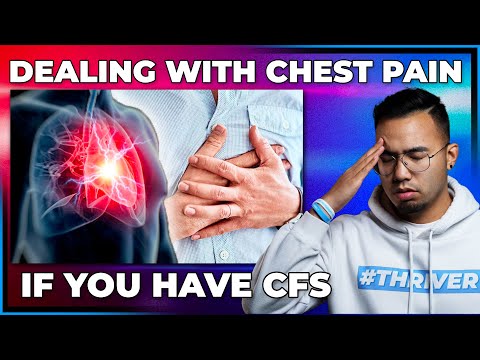
Chest Pain Was One of My Scariest Symptoms
Sharp pains in my chest. Shooting pains. A weird tingling, numbing ache running down my left arm. For a stretch of the time I was sick I had this almost every day, and every single time my brain jumped to the same place: something serious is happening with my heart.
I had it all the time, and many people I talk to have it too. It's one of the scariest things you can go through, because it feels exactly like what you'd picture when you imagine a heart problem. One sharp stab and your whole day changes.
So, of course, I did what everyone does. I went to Google. "Why is there pain going down my left arm and I have chest pain?" You can guess what I read, and you can guess how I felt afterward.
I recovered from 50+ symptoms and hospitalization, and chest pain was high on that list. This post is for you if you've been dealing with chest pain, shooting pain, or sharp pains along with fatigue and other symptoms nobody can explain. I'm going to share what I learned about why it happened to me and what helped me stop fearing it. One thing first, and I'll say it a few times because it matters.
Get Your Heart Checked First
Before you take anything I say seriously, get checked out. Doctors, specialists, scans, an ultrasound, a Holter monitor, whatever your doctor orders. If you've got palpitations or a racing heart rate too, get those looked at as well. Those come up a lot in the people I talk to, they're scary, and you deserve answers from someone with a medical license.
We're a coaching and education team, not doctors. Take everything I say with a grain of salt until your tests are done. If something shows up, that's a medical issue to handle with your doctor.
But chances are, if you're reading this, you've already been through all of it. They scanned your heart and told you it looks fine. And that can be so frustrating, because they look at you like you're imagining it, and you know something's off. Does a normal heart skip that many times in a day? Do most people get shooting pain down their arm while reaching for a glass of water? Those were the questions that kept me up at night. We wrote about that exact frustration in normal tests but you still feel sick.
If your tests are clear and the pain keeps showing up, the rest of this is about what I did when I was in that same spot. In my case the tests were clear and my nervous system was on high alert. Chest pain went under the same umbrella as every other symptom my doctors couldn't find a cause for.
My Brain Worked Like a Magnifying Glass
A lot of people dealing with what gets called chronic fatigue syndrome have chest pain on their list too. In my case, I came to think of what I had as a hypersensitive nervous system, because that's what my doctor explained was going on in my body. Every unexplained symptom I had, the chest pain included, went under that one umbrella.
The thing about chest pain, for me, was that I'd feel the smallest sensation, a tiny twinge, and my brain would blow it up. It worked like a magnifying glass. And the more I feared a certain symptom, the more my brain seemed to go, "That one. We'll make that one stand out even more." So it kept triggering it.
My doctor explained it to me this way. A burn or a sprained ankle hurts where the injury is. The kind of long-running pain I had, he said, was being handled upstairs, in the brain. So when I got those sharp shooting pains in my chest, it was a false alarm going off upstairs.
Did the pain hurt? Absolutely. It was pain, and I felt every bit of it. The way my doctor put it, mine was a signal from a brain on high alert. Our post on central sensitization goes deeper on the idea of a sensitive nervous system turning the volume up on normal signals.
Miguel's name for what he noticed in his own body: a tiny sensation that his brain blew up into sharp, shooting pain. The more he feared a symptom, the more it showed up. Chest pain was the one his brain magnified most, and easing the fear around it was the work he did.
Why My Body Sent Pain to Keep Me Put
The way my doctor explained it to me, the whole purpose of a lot of my symptoms was to slow me down. They were signals telling me to stop moving, stop doing, stay put. My body thought it was in danger, so it threw me into freeze mode, or that extreme fight or flight mode where every alarm and warning light goes off at once.
That's what happened, in my case, when I went over my stress threshold. Once I crossed it, my body did anything and everything it could to keep me still so it could keep me safe. Even if that meant something that felt like a problem with my heart. Even if that meant chest pain.
I'd feel it going up the stairs. I'd feel it when I left the house for a short walk. The way I understand it now, and the way my doctor explained it to me, my body had learned that chest pain was the thing that stopped me from going out and doing those things again.
I want to be careful here. I kept listening to my body, and I learned to carry far less fear about the pain. Those were two separate things for me, and the fear is where my work was.
Chest Pain Was My Kryptonite
We all have a kryptonite in recovery. One symptom that gets past all your logic. For me, at one point, it was my heart rate and the chest pain. If something serious was going to happen to me, I was sure it would be my heart.
Having talked to so many people around the world about this, chest pain comes up again and again as the one that gets past logic. For me, it took telling myself, hundreds of times, "It's just my nervous system."
And even when I knew this, even when I believed it, something happened when the pain showed up. Logic went out the window. I slid into a very emotional state. On a quiet day, seeing it as the nervous system was easy. When the pain hit, everything changed. Mike Tyson said everybody has a plan until they get punched in the face. Chest pain was my punch in the face.
That's why it helped me to know the symptoms that got to me most. Until I worked on them, I stayed stuck. Progress came while I was still in the middle of rewiring it, calming down that instant anxiety response when the pain hit. It was a work in progress. I worked on it constantly, and I reminded myself constantly.
That's also where having people around me who understood this made a difference. My doctor would tell me, "This is an adjustment period." Hearing it from him, when I was in the middle of it, settled me in a way I couldn't settle myself. Our post on getting through a flare-up walks through what that looked like for me in practice.
What My Fitbit Taught Me About Fear
Something interesting happened whenever I got anxious about a symptom. For me, it got worse. I learned this the hard way with my heart rate.
I wore a Fitbit because my whole goal was to keep my heart rate low. My resting heart rate at the time was 90 to 100 beats per minute, even lying down. So I'd sit up to drink some water or start eating, and I'd check. 105. 110. The more I watched those numbers climb, the more anxious I got. And the more anxious I got, the higher they seemed to climb.
It was a feedback loop. Heart rate goes up a bit. I get a bit more anxious. Heart rate goes up more. I get more anxious. Round and round, until I was sitting in a chair at 140 or 150 having a mini panic attack. Looking back, I think the fear was feeding the loop.
So I took mine off. The data was feeding my fear, and my fear seemed to be feeding the symptom. We've got a whole post on heart rate monitoring and how to think about the numbers.
One more thing I noticed as I recovered. There were times I was completely fearless about my symptoms, especially the heart rate, and it still went up. For me there was a difference between having a physical symptom and reacting to it mentally. The physical side was already there. The mental side poured gasoline on the fire. Once I stopped adding the fuel, the fire had far less to burn.
The Five Words I Told Myself
Sometimes the chest pain was a loop that kept playing. Sometimes it was random. I'd be relaxed, thinking about anything but my heart. I'd reach for a glass of water, take the first sip, and there it was. That was normal for me, and I wish I'd known it going in.
The more I feared it, the more it showed up, and before long I was monitoring the pain in my chest all day. I lived there for a while. It was exhausting.
Every time it hit, I told myself, over and over: "It's just my nervous system." Those are the five words I used for every symptom, every time. It's just my nervous system warning me and trying to keep me put. It's fine.
Our guide on brain retraining and symptoms goes deeper on the idea behind those five words.
Because something shifted for me after a while. I'd had this pain hundreds of times. I'd been checked. I was still here, doing fine. At some point I thought, "I've felt this so many times and nothing has come of it. There's no point stressing about it." And I noticed that stressing about it had been doing two things: keeping me stuck longer, and, as far as I could tell, making the symptom worse.
The Golden Rule of Recovery
The other line I'd remind myself of is one my doctor gave me. I call it the golden rule of recovery: in my recovery, how I responded to symptoms made the biggest difference.
Whenever I brought that up in my head, I'd check in. "Okay, how am I responding to this right now?" Oh. I'm panicking. I'm starting to freak out. I'm worried. Well, that won't help me much, will it? Because how I responded was the one part I could control.
The symptoms were still there. I was feeling them. The question was what I did with them. Could I stay composed? Cool, calm, collected, as much as I could manage? Staying composed looked different from sitting like a monk while my body flared up. It was uncomfortable. But was I adding fuel to the fire, or was I letting the fire cool off? Was I staying centered? Was I reminding myself it's just the nervous system?
That's what made the difference for me. My nervous system was stuck, not broken. And every time chest pain showed up and I met it with "it's just my nervous system" rather than a Google search, I was teaching my brain that the alarm could stand down.
If you're dealing with chest pain right now and your tests are clear, I've been exactly where you are. The five words, the golden rule, and people who understood what I was going through are what got me through it. I hope this helps you see the symptom a little differently, starting with the next time it shows up.
TL;DR Summary
- Sharp, shooting chest pain with clean heart scans was one of Miguel's scariest symptoms, and he had it almost every day at one point
- Get your heart checked first. Scans, an ultrasound, a Holter monitor. Everything in this post is about what Miguel did after his own tests came back clear
- Miguel's brain worked like a magnifying glass. The more he feared a symptom, the more his brain blew it up and kept triggering it
- Miguel's doctor explained to him that his long-running pain was being handled upstairs, in the brain. The pain still hurt, and in his case it was a false alarm sent to keep him put
- Miguel's Fitbit showed him the fear loop: watching his heart rate climb made him anxious, and the numbers kept climbing while he watched
- Miguel told himself 'It's just my nervous system' hundreds of times, and judged his progress by the line his doctor gave him: how he responded to symptoms made the biggest difference