A Complementary Recovery System for Your ME/CFS, Long COVID & Fibromyalgia Patients
CFS Recovery is a coaching-based nervous system retraining recovery system with published outcome data from 5,000+ Nervous System Health Assessments (our proprietary measure) and the standardized SF-36 Health Survey. It's built to work alongside your clinical care.
Review our evidence from 2,300+ unique clients, methodology, and referral pathway below.
The Clinical Challenge You're Facing
Your ME/CFS, Long COVID, and fibromyalgia patients present a difficult clinical picture:
- Standard diagnostics return normal results
- Pharmacological interventions manage symptoms but don't resolve the underlying condition
- Patients cycle through specialists without improvement
- The conditions are chronic, debilitating, and associated with high healthcare utilization
- Patients are frustrated, discouraged, and often feel dismissed
The clinical tools available for these conditions are limited.
The Gap, and Where We Fit
CFS Recovery focuses on the nervous system side of these conditions, through coaching and education, alongside the medical care your patients already receive.
CFS Recovery is a structured, coaching-based recovery system that works alongside your clinical management. Your patients' medical care stays with you and their other clinicians. Many of our clients continue seeing their physicians, specialists, and allied health professionals throughout their recovery.
Our Role
Systematic nervous system retraining through daily practice, coaching, and progressive capacity building. Delivered by coaches who have personally recovered from these conditions.
Your Role
Clinical oversight, medication management, and ongoing medical monitoring. Your clinical expertise remains central to your patient's overall care.
Together: a more complete approach.
Published Outcome Data: Two Assessment Instruments
CFS Recovery tracks client outcomes using two complementary assessment tools: our proprietary Nervous System Health Assessment (NSHA) across 2,300+ clients, and the SF-36, a clinician-recognized standardized health survey used in clinical research worldwide.
Practitioners can explore our live SF-36 outcomes dashboard (interactive, refreshed nightly, de-identified, code-gated). Email [email protected] with your name, role, and clinic to request an access code and our practitioner packet, or message us on LinkedIn.
Nervous System Health Assessment (NSHA)
Our proprietary assessment maps cognitive capabilities (7 sub-domains), physical capabilities (7 sub-domains), symptom load, polarization patterns, and activity levels. 817 clients completed 2 or more assessments, giving within-person before-and-after data over a median tracking period of 123 days (about 4 months).
SF-36 Health Survey (Standardized)
The SF-36 is a standardized health survey widely used in clinical research. We score it with the standard RAND-36 method: eight domains, each on a 0 to 100 scale where higher is better. Each client is compared with their own baseline, and change is shown in points. Of the 829 clients who completed a baseline survey, 178 have a counted baseline and follow-up, a median of 5.8 months apart. Their average change across all eight domains was +21.7 points.
| SF-36 Domain | Baseline | Follow-up | Change (95% CI) | % With a Higher Score |
|---|---|---|---|---|
| Physical Functioning | 45.6 | 68.0 | +22.4 (±3.4) | 82% |
| Role Limitation (Physical) | 4.2 | 26.6 | +22.4 (±5.3) | 44% |
| Role Limitation (Emotional) | 20.9 | 53.7 | +32.9 (±6.8) | 54% |
| Energy / Fatigue | 23.6 | 43.8 | +20.2 (±3.1) | 79% |
| Emotional Wellbeing | 48.3 | 64.9 | +16.6 (±2.8) | 76% |
| Social Functioning | 34.6 | 61.2 | +26.6 (±3.7) | 82% |
| Pain | 57.9 | 70.2 | +12.2 (±3.8) | 55% |
| General Health | 29.6 | 50.1 | +20.5 (±4.0) | 76% |
| Average Change (All 8 Domains) | +21.7 | |||
Scores run from 0 to 100, and higher means better health in every domain, including pain (a higher pain score means less pain). Change is each client's follow-up score minus their own baseline, averaged across clients, with its 95% confidence interval. % With a Higher Score is the share of clients whose score went up. Every domain includes 178 clients except social functioning (177). Change is calculated before rounding, so a few rows differ by 0.1 from the rounded baseline and follow-up columns. The pairing rule is in the SF-36 methodology and collection protocol below.
By time between surveys. Average change across all eight domains was larger among clients with more time between their baseline and follow-up. Each row is a different group of clients, and those groups may differ in ways beyond time, so read this as an observed pattern.
| Months Between Surveys | Clients (n) | Average Change (All 8 Domains) |
|---|---|---|
| 0 to 6 | 100 | +17.7 |
| 6 to 12 | 47 | +25.0 |
| 12+ | 31 | +29.7 |
Average Change by Baseline Need
We split the 178 paired clients into thirds by their average baseline score. Average change across all eight domains was +24.4 points for the highest-need third (n = 59), +23.0 for the moderate third (n = 60), and +17.8 for the milder third (n = 59). Part of this gap is likely regression to the mean: clients who start near the floor tend to score higher when measured again, whatever happens in between. We present it as an observed pattern worth studying.
Limits to keep in mind. This is an observational pre/post measure with no control group. Clients who complete follow-up are self-selected and may differ from those who don't, which can bias results upward. So far, 21.5% of everyone who took the baseline survey has a counted follow-up (178 of 829). Among clients whose baseline was at least 12 months ago, the figure is 25.4% (177 of 698).
See the live SF-36 dashboard at cfsrecovery-sf36-outcomes.vercel.app. It refreshes nightly and shows only de-identified data. Its figures may shift slightly from this September 16, 2026 snapshot as new surveys come in. Verified clinicians get the access code by email. Write to [email protected] with your name, role, and clinic.
Data Notes for Practitioners
- These are observational outcomes from a coaching-based recovery system, with no placebo control or randomization
- NSHA tracks cognitive and physical capabilities on a 0-5 scale across 14 sub-domains, plus symptom inventory, polarization patterns, and activity level
- SF-36 change is measured within the same client, from their baseline survey to their latest qualifying follow-up (median 5.8 months apart)
- We publish our data with its limitations stated
- Full domain-level breakdowns and methodology documentation available on request
- We welcome conversation about our methodology and data with interested practitioners
The Full Outcome Documents
Our earlier outcome documents, published in full. They predate the September 2026 update, so some figures differ from this page. Nothing is gated and none of these ask for your email. Each one opens in a new tab.
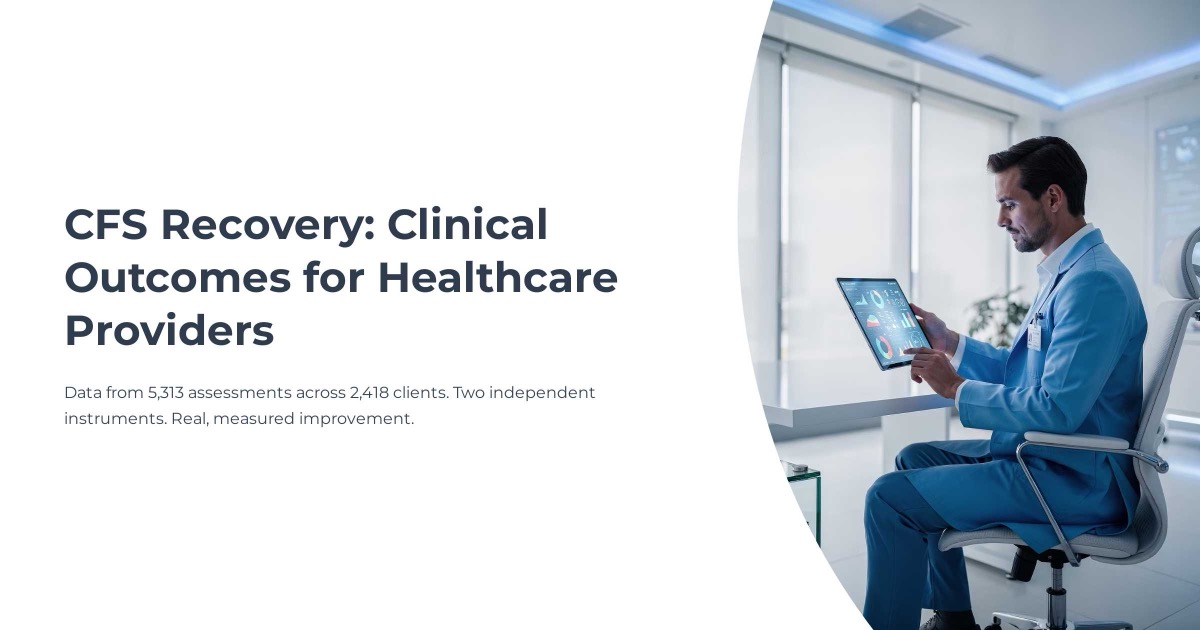
Clinical Outcomes for Healthcare Providers
The overview. Who we serve, severity at intake, both assessment instruments, outcomes across all eight SF-36 domains, and what referral involves.
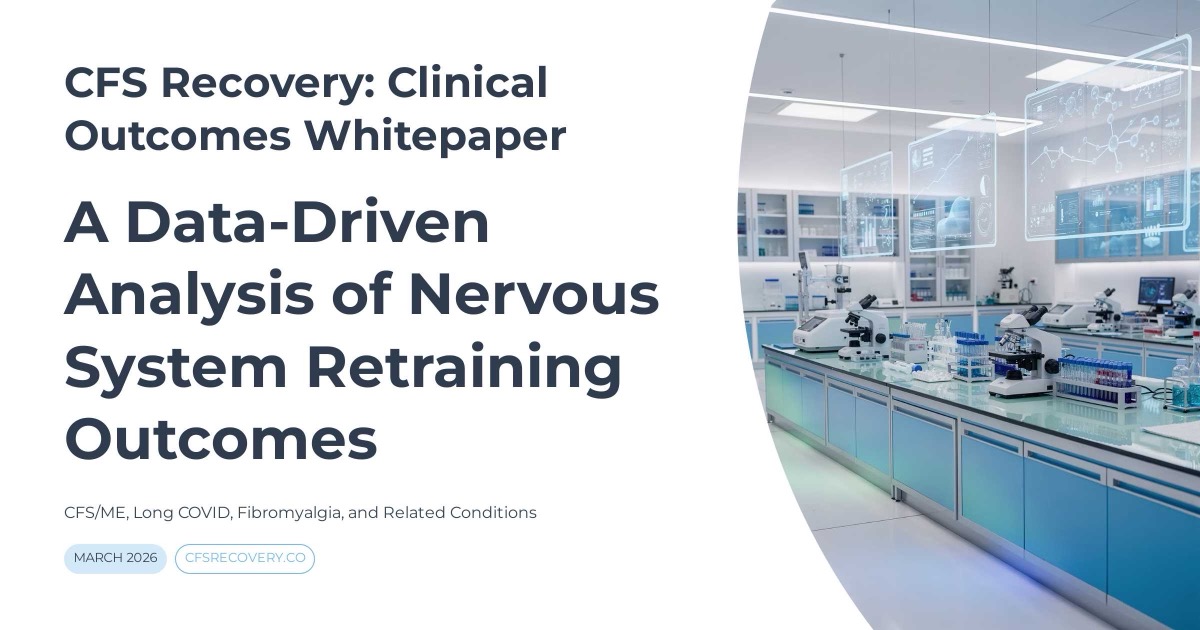
A Data-Driven Analysis of Nervous System Retraining Outcomes
Instruments, demographics, baseline capability scores, domain-by-domain results, cross-instrument validation, and the methodology and limitations in full.
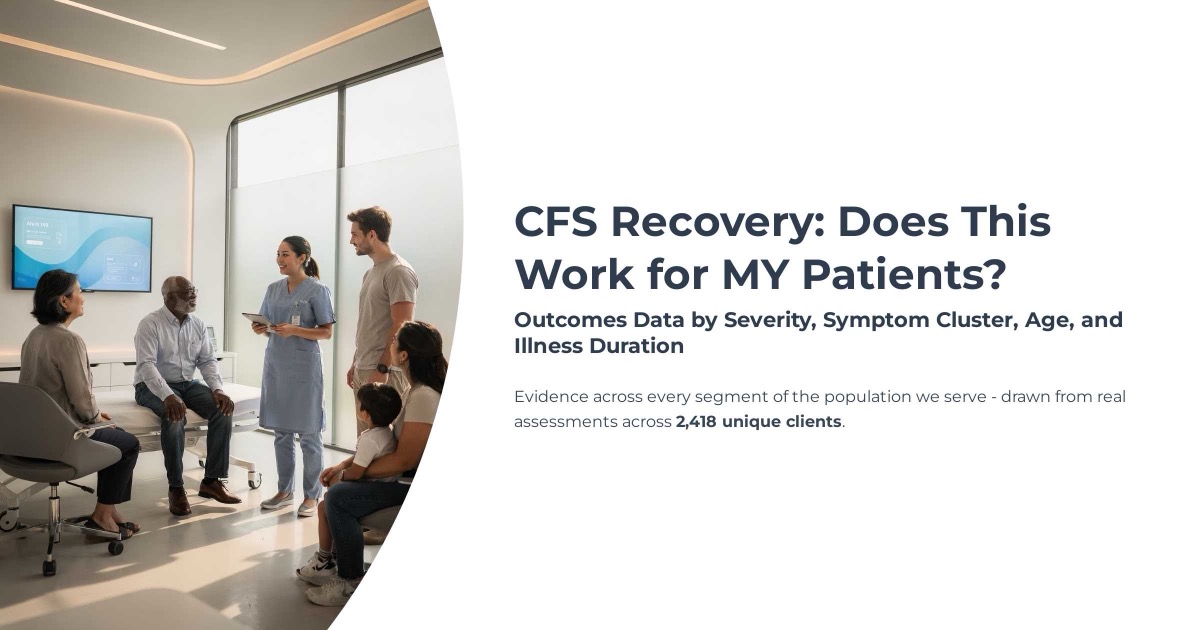
Does This Work for MY Patients?
Outcomes broken out by severity, symptom cluster, age, and illness duration. Open this one if you already have somebody in mind and want to know whether they fit.
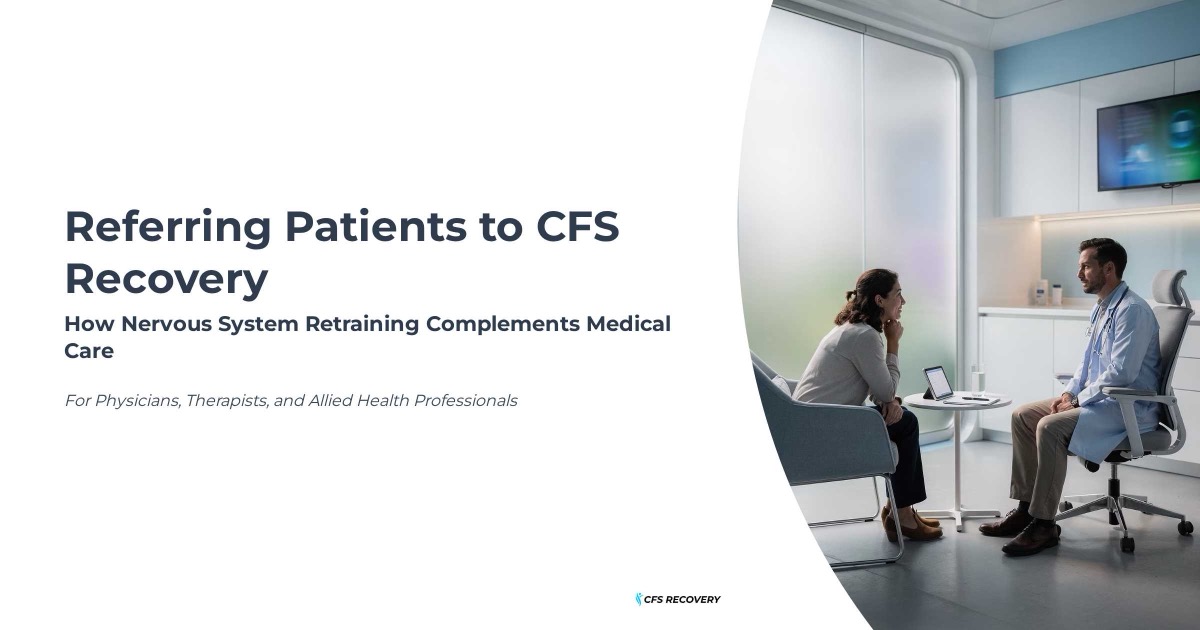
Referring Patients to CFS Recovery
What we do, what we will never do, what happens after you refer, and what comes back to you. No forms, no coordination burden on your end.
SF-36 Outcomes: Methodology & Collection Protocol
Version 1.1 · September 2026 · Owner: Miguel Bautista
This is how we measure client health outcomes with the SF-36, the rules for when surveys are sent and who is included, and the safeguards that keep the data accurate and reproducible. Outcome data has been collected since December 2023, and collection was standardized under this protocol in June 2026.
Study Design
- Observational pre/post design. Each included client contributes one baseline survey (Survey 1) and one follow-up survey (Survey 2), chosen by the pairing rule under Matching and reporting. Change is measured in points, within the same person, across the eight SF-36 domains.
- No control or comparison group. Results describe outcomes observed among participants and can't be attributed to the recovery system alone (see Limitations).
Scoring
- Scored with the standard RAND-36 algorithm: eight health domains, each on a 0 to 100 scale (higher is better), each computed as the mean of the participant's non-missing items.
- Deterministic and unit-tested. Identical inputs always produce identical outputs, and an automated test suite verifies the implementation, so the outcomes are fully reproducible.
Limitations (stated for transparency)
- Observational and uncontrolled. Scores are measured within the same person over time. Without a comparison group, the data describe change observed among clients and can't show that the recovery system alone caused it.
- Self-selection. Clients who complete the follow-up survey may differ from those who do not, which can bias results upward.
- Repeat baselines. 48 of the 178 paired clients took Survey 1 more than once, so some baselines come after time in the recovery system.
- Instrument scope. The SF-36 measures function and quality of life. It does not measure post-exertional malaise (the defining feature of ME/CFS). A normal-range SF-36 score reflects functioning on this instrument only. Whether a patient has recovered is a clinical judgment.
- Email-based matching. Differing or mistyped email addresses between surveys can cause missed pairings.
View the full collection protocol
Surveys
- Survey 1 (Baseline): sent when a client joins the recovery system ("Day 1"), before meaningful exposure to it.
- Survey 2 (Follow-up): sent once per participant, per the timing rules below.
Follow-up timing
- Academy (monthly): Survey 2 is sent at the 6-month mark, or upon cancellation, whichever comes first.
- Platinum (fixed-term): Survey 2 is sent at the end of the contracted term, 6 months for the 6-month product or 12 months for the 12-month product, or upon early cancellation, whichever comes first.
- Grace window: a follow-up is considered on-time if completed within plus or minus 30 days of its target date.
Inclusion and exclusion
- Included: participants whose Survey 1 and Survey 2 meet the pairing rule under Matching and reporting.
- Excluded: staff and test submissions.
- One-month minimum (not yet applied): the protocol calls for excluding free trials and anyone who left before completing one full paid month of the recovery system. The published figures don't apply this rule yet.
Matching and reporting
- Survey 1 and Survey 2 are paired by the participant's email address. Each participant's follow-up is their latest Survey 2 that has a Survey 1 at least 30 days before it, and their baseline is the most recent Survey 1 at least 30 days before that follow-up. Staff and test submissions are excluded. A unique customer identifier carried into both surveys is a planned upgrade.
- A participant's Survey 2 target date is 6 months after Survey 1 for Academy and the 6-month Platinum product, and 12 months after Survey 1 for the 12-month Platinum product. Follow-up completion is published two ways: across everyone who completed Survey 1, and among participants whose Survey 1 was at least 12 months ago, which is at or past the target date for every product.
- Each Survey 2 is recorded with its trigger (6-month milestone, end-of-term, or cancellation) and the participant's tenure at the time of sending.
Change History
- Version 1.1 (September 2026): Pairing rule revised. Each follow-up is the participant's latest Survey 2 that has a Survey 1 at least 30 days before it, the baseline is their most recent Survey 1 at least 30 days before that follow-up, and staff and test submissions are excluded. Published results now show within-person change in points, replacing the earlier tenure-band summary. The one-month minimum under Inclusion and exclusion isn't applied to the published figures yet.
- Version 1.0 (June 2026): Initial documented protocol. Outcome data collected since December 2023, standardized under this protocol in June 2026.
Recovery System Methodology
CFS Recovery's coaching draws on five areas of neuroscience research:
Neuroplasticity
Structured, repeated daily practice, informed by research on how the brain changes with experience.
Autonomic Nervous System Regulation
Practices designed to help clients notice and shift between stress and rest states, drawn from research on autonomic balance.
Central Sensitization
Gradual exposure and body-based practices, drawn from research on how the nervous system processes sensory signals.
Chronic Stress Response
Practices for calming a long-running stress response, informed by research on the HPA axis and allostatic load.
Psychoneuroimmunological Principles
Education on the two-way connection between the nervous system and the immune system, alongside nervous system regulation practices.
Recovery System Components
| Component | Description |
|---|---|
| Video Curriculum | 100+ hours of structured recovery modules (self-paced) |
| NSHA Assessment | Nervous System Health Assessment: maps cognitive and physical capabilities across 14 sub-domains, symptom load, polarization patterns, and activity levels. 5,000+ assessments completed to date |
| Live Coaching | 7 group coaching calls per week with recovered Thriver Coaches (Academy + Platinum tiers) |
| 1:1 Coaching | Private sessions with senior coaches (Platinum tier) |
| Community | Peer support via Skool and Discord platforms |
| Progress Tracking | SF-36 Health Survey (standardized, RAND-36 scored) and NSHA (proprietary). Both are compared within-person over time: 817 clients have 2 or more NSHA assessments, and 178 clients have a counted SF-36 baseline and follow-up |
Important Positioning
CFS Recovery is a coaching-based recovery system. We do not diagnose, prescribe, or provide medical treatment. Our coaches are trained in coaching methodology and nervous system retraining. They are not licensed healthcare practitioners.
We encourage all clients to maintain their relationship with their healthcare providers throughout their recovery.
Physician Endorsement
Dr. Resnick reviewed CFS Recovery's methodology and an earlier version of its outcome data, before the September 2026 update. His endorsement reflects his clinical observation of patients with ME/CFS, Long COVID, and fibromyalgia who used the recovery system.
What Your Colleagues Are Saying
GPs, therapists, and others with healthcare or scientific backgrounds who've reviewed our recovery system firsthand. All six are public reviews on Trustpilot.
"Excellent [recovery system] - I'm a GP in Uk and will recommend to my patients who have ME/CFS /longcovid use this resource"
"What you will find here cannot be found in the mainstream Healthcare Community, believe me I tried for over 3 years between MD's, lab work, psychotherapists, and on and on and on. Try this, you've got nothing to lose, take this from a psychotherapist / social worker with over 30 years of experience in the healthcare field."
"As someone with a scientific and medical background I've done a lot of reading and research into CFS / Long covid since contracting it myself. What Miguel teaches fits in well with the neuropsychology of what we understand about these conditions so far. ... Miguel simplifies this and provides excellent support and hope in his [recovery system]. This [recovery system] has helped me a lot and I am very greatful for all of miguels free resources too."
"I am a healthcare professional, and I would absolutely not endorse this if I didn't believe in it. The coaching team are amazing, I've met the best people through the community, and I have seen mind blowing transformations. I was couchbound for a year before I started this. Now, I am back at work, caring for my child, working out in the gym, travelling, and excited for my next chapter of life."
"As a therapist and coach myself for many years, I approached the coaches with an inner question of whether they could earn my trust. Yes, they did! I am full of respect and recognition for the professional attitude, empathy, and helpful reflective questions with which they manage to help participants."
"Before falling ill with COVID-19, I was an embodiment of ambition and drive. I worked as an outpatient physical therapist in a super fast-paced clinic working 10-12 hour days. The Recovery Jumpstart [recovery system] offered me a roadmap to thrive again! I can confidently say that joining [it] has been the best investment of my entire life."
How to Refer a Patient
Referring a patient to CFS Recovery is simple. Choose the option that works best for your practice.
What Happens After Referral
- Your patient receives an introduction from our team
- They take the NSHA assessment to map their nervous system state
- They choose their recovery system tier (starting at $47/month)
- They work through the recovery system alongside your clinical care, with live coaching if they choose Recovery Academy or Recovery Academy Platinum
- You can request progress updates (with patient consent)
We do not charge practitioners for referrals. There are no referral fees or partnership costs. We simply want your patients to have access to a recovery system that complements your care.
Practitioner FAQs
Is CFS Recovery a medical treatment?
▼What training do your coaches have?
▼Can I see your outcome data methodology?
▼Will my patient need to stop any medications or treatments?
▼How do I know if my patient is a good fit?
▼Can I receive updates on my patient's progress?
▼What about bedbound or housebound patients?
▼Is there a practitioner partnership or affiliate program?
▼Your Patients Deserve a Complementary Option.
We're Here to Provide It.
Over 5,000 assessments. 2,300+ unique clients. Published SF-36 and NSHA outcome data. Live coaching from recovered coaches. And a recovery system designed to work alongside your clinical care.
If you have patients with ME/CFS, Long COVID, fibromyalgia, or related conditions who need more than standard medical management can offer, we're ready to help.
Questions? Contact us →